
Like many countries around the world, Tanzania is a State party to several
international investment agreements (IIAs) or international investment treaties.
Notably, the abbreviation IIA, as used in this book, stands for all international
investment treaties and treaties with investment provisions (TIPs). The most
common type of IIAs are bilateral investment treaties (BITs), defined by
the United Nations Conference on Trade and Development (UNCTAD) as
agreements between two countries for the reciprocal encouragement, promotion
and protection of investments in each other’s territories by companies based in
either country. According to UNCTAD, BITs were initially concluded ‘in order to
secure additional and higher standards of legal protection and guarantees for the
investments of its firms than those offered under national laws.’1 The developing
country, on the other hand, would sign a BIT as ‘one of the elements of a
favourable climate to attract foreign investors.’2
The other types of IIAs are multilateral investment treaties (MITs), which are
agreements between countries that establish common standards for finance and
reciprocal investment. MITs are designed to: (i) ensure fair and equitable treatment
of rights of foreign investors; (ii) create shared State obligations to support
international investment; (iii) unify legal frameworks into a cohesive international
finance strategy; and (iv) provide a stable and consistent treatment of foreign direct
investment (FDI) across all sectors in each of the States parties to the respective
MIT.
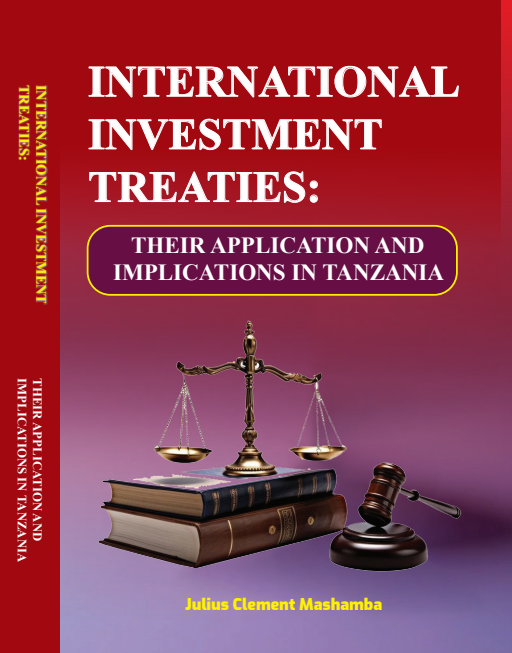
INTERNATIONAL INVESTMENT TREATIES in Tanzania Their Applications and Implications in Tanzania 8 August 2025
Original price was: TZS60,000.00.TZS50,000.00Current price is: TZS50,000.00.
Like many countries around the world, Tanzania is a State party to several international investment agreements (IIAs)
or international investment treaties (IITs), including treaties with investment provisions (TIPs) and international taxation
agreements such as double taxation and tax treaties (DTTs). IIAs, which are agreements between two countries seeking
for the reciprocal encouragement, promotion and protection of investments in each other’s territories by companies based
in either country; they strive to secure additional and higher standards of legal protection and guarantees for foreign
investment host States in developing countries, which do sign an IIA in order to attract foreign direct investment (FDI).
While there are currently more than 3,300 IIAs and over 3,000 DTTs globally, Tanzania has signed about 20 BITs and more than
a dozen DTTs with various countries. Tanzania has also signed six TIPs with regional economic blocs. In addition, Tanzania
is a signatory to other global investment instruments, including the Convention on the Recognition and Enforcement of
Foreign Arbitral Awards of 1958 (‘the New York Convention’), the International Convention on Settlement of Investment
Disputes of 1965 (‘the ICSID Convention’), and the UN Guiding Principles on Business and Human Rights. Universally, IIAs
have tended to have two features: firstly, they offer foreign investors legal protection through which investors have the
right to seek compensation for adverse acts committed by the host State in international arbitral tribunals under the
ISDS system. Secondly, IIAs are a key tool for countries seeking to attract FDI, particularly developing countries (often
called ‘capital-importing States’) such as Tanzania.
The main consequence of most IIAs containing ISDS provisions is the proliferation of ISDS cases whereby many disputes
that have arisen out of, or under, such IIAs have been referred to major international arbitration institutions in the
ISDS system by aggrieved investors. Globally, by the end of 2024, there were more than 1,300 “known” ISDS cases – raising
from 1 in 1987 when the International Centre for Settlement of Investment Disputes (ICSID) received its first ever ISDS
case – Tanzania has been sued in more than 20 ISDS cases over the past twenty years, whereby it has been slapped
with more than US$190 million in compensation to foreign investors who have taken the State to the ISDS-based
international arbitral tribunals for breaching its purported treaty obligations.
As a consequence to these exorbitant compensation sums, many capital-importing States, particularly those in
Africa, have started to agitate for a fairly equal level-playing field for both parties in IIAs and the ISDS system: States
are now advancing the cause for equal protection between investors and host States in international investment treaty
arbitration. This ensures that, while it is entitled to numerous protections, the investor also has some obligations towards
the host State and its nationals in case of violation of certain international law fundamental principles such as human
rights and rule of law, environmental rights, corruption, and public policy (including observation of the host State’s law
and tax obligations).
A number of challenges have constrained Tanzania in its IIA arrangement, including poor negotiation of the IIAs,
investor over-protections inherent in the IIAs, lack of a harmonised statutory and regulatory frameworks for investors in
the country, skills and capacity constraints, lack of effective knowledge management, lack of coordination of state
agencies dealing with foreign investors, and lack of public awareness on IIAs and their positive benefits.
Therefore, this book strives to examine not only the underlying principles IIAs, but also the critical issues relating
to investor protections and state obligation towards foreign investors. It also canvasses the ISDS process, procedure
and practical issues in order to provide a clear understanding to Tanzanian practitioners of the ISDS system. At the
end, the book lists down recommendations aimed at strengthening Tanzania’s participation in the negotiations for IIAs
and their implementation because, given the current direction that Tanzania has taken, IIAs are there stay; and, so, they
need effective negotiation, renegotiation and management.
Julius Clement Mashamba is a Senior Lecturer in Law and Ag. Deputy Principal (Training, Research and
Consultancy) at the Law School of Tanzania. He is also an Advocate of the High Court of Tanzania since 2002. Between
April 2018 and July 2020, Mashamba served as the Solicitor-General of the United Republic of Tanzania. He also served
as a member of the African Committee of Experts on the Rights and Welfare of the Child (ACERWC) between July 2010
and March 2021. Mashamba lectures on international dispute resolution, international arbitration law and alternative
dispute resolution (ADR), civil litigation, fraud examination and law, constitutional law, human rights law and child rights,
in several Tanzanian and Southern African universities.
Mashamba is also an accredited arbitrator and mediator listed on the Kigali International Arbitration Centre (KIAC),
the Arbitration Foundation of Southern Africa (AFSA)/Southern African Development Community (SADC) Panel of
Arbitrators, the Tanzania Arbitration Centre (TAC), the Tanzania International Arbitration Centre (TIAC), and the
Tanzania Institute of Arbitrators (TIArb.). He has written extensively on International ADR, International Arbitration,
International Human Rights Law, International Dispute Resolution, Civil and Criminal Litigation, Advocacy Skills, and
International Child Rights Law.
Related products
- ARBITRATION
ARBITRATION Law and Practice in Tanzania 2nd FINAL
Original price was: TZS60,000.00.TZS50,000.00Current price is: TZS50,000.00. Add to cart

Reviews
There are no reviews yet.