
The legal profession is held to be a learned and noble vocation because it frequently works for good causes that benefit the common people. By serving and guarding the law, lawyers perform a crucial function in the society; hence, the nobility of the legal profession. Moreover, the legal profession is held to be a noble profession because lawyers are tasked with upholding and ensuring that justice is served. For that matter, lawyers are trained to interpret and apply the law, advocate for their clients, and maintain ethical standards. Additionally, the law is essential to maintaining a just and equitable society, and lawyers play a critical role in upholding the law and ensuring that individuals and organizations are held accountable for their actions. Lawyers also provide a valuable service to their clients, helping them navigate through complex legal systems, court procedures and protecting their rights and interests. Because of the nobility of their profession, lawyers are required to be specifically trained and skilled in the law (both substantive and procedural law) and abide by strict rules of ethical conduct.
This book canvasses the professional conduct and ethics of lawyers in all branches of the legal profession
in Tanzania – i.e., the Bench, the Public Bar and the Private Bar. Notably, lawyers, in all branches of the legal
profession, bear special duties and responsibilities: duties to their clients and stakeholders in the justice system; duties to the legal system; duties to their institutions; and duties to the society at large. In addition, the book examines how the legal profession should be practised as a business – that is, in today’s schemes of things, law should be practiced not only as a public service, but also as a business just like any other businesses such as medical practice, engineering and banking.
The legal profession imposes special ethical responsibilities on its members towards each other, the legal
profession, their clients, the court, and the public. In order to maintain public confidence and trust in the legal profession, strict rules of professional conduct and ethics are imposed on members of this noble profession.
Such rules are set out in various codes of conduct and ethics for almost all major branches of the legal profession in Mainland Tanzania as considered in this book. From the three major branches of the legal profession (i.e., the Judiciary, the Private Bar and the Public Bar), we also have three broad categories of procedures for enforcement of professional conduct and ethics for lawyers in Mainland Tanzania. Where a lawyer in practice breaches such ethical rules, he/she is subjected to either disciplinary actions before disciplinary authorities considered in this book or criminal proceedings before courts of law. As such, this book canvasses the existing disciplinary authorities for the enforcement of professional ethics for lawyers in Mainland Tanzania. As well as considering the establishment and composition of the disciplinary authorities, the book canvasses their jurisdiction, mandate powers and procedures applicable in relation to the enforcement of ethics for lawyers.

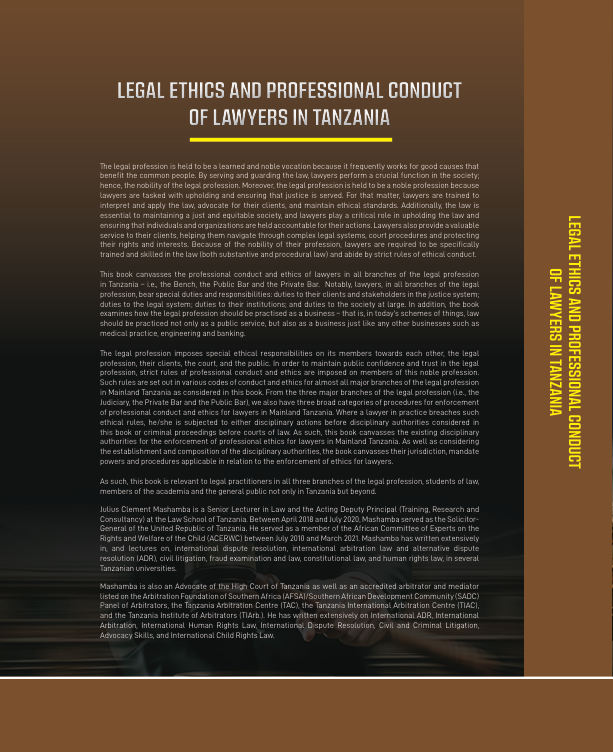
LEGAL ETHICS AND PROFESSIONAL CONDUCT OF LAWYERS IN TANZANIA
Original price was: TZS40,000.00.TZS35,000.00Current price is: TZS35,000.00.
This book canvasses the professional conduct and ethics of lawyers in all branches
of the legal profession in Tanzania – the Bench, the Public Bar and the Private Bar.
The legal profession is held to be a noble1 and learned vocation because, like medical
practitioners, legal practitioners have, for decades, been regarded as professionals
who render services to the public. Whereas medical practitioners cure diseases, legal
professionals protect the public from socio-legal problems; thus, they cure socio
legal diseases. The legal profession is regarded as a noble profession because it
frequently works for good causes that benefit the common people, and because the
fundamental essence of this vocation is good. By serving and guarding the law,
lawyers perform a crucial function in the society; hence, the nobility of the legal
profession.
Related products
- ARBITRATION
ARBITRATION Law and Practice in Tanzania 2nd FINAL
Original price was: TZS60,000.00.TZS50,000.00Current price is: TZS50,000.00. Add to cart - ARBITRATION
A DIGEST OF CASES ON ARBITRATION AND PRACTICE IN TANZANIA – Volume 1, 2025
Original price was: TZS30,000.00.TZS25,000.00Current price is: TZS25,000.00. Add to cart - DISPUTES RESOLUTION
ALTERNATIVE DISPUTERESOLUTION IN TANZANIA
Original price was: TZS60,000.00.TZS50,000.00Current price is: TZS50,000.00. Add to cart



Reviews
There are no reviews yet.